

Home / Guides / Blinds on a hot night
Guide · hot nights
Blinds on a hot night: when to close them, when to open them
On a hot day, keep the bedroom's blinds or curtains closed from before the sun reaches the window until sunset, then open the window to the evening air and try a fan before the air conditioner, so the room starts the night holding less of the day's heat.
Four pages from three authorities that publish hot-weather advice give the same first step for a cooler home on a hot day. That step happens hours before bedtime: close the coverings while the sun is up. We put their pages side by side, and the count is our own:
- energy.gov.au says that in warmer months you should close coverings during the day to keep the home cool.
- The NSW Government's summer tips say to close doors, windows, blinds and curtains during the day.
- The NSW hot-weather page says to close curtains "or consider external shading if the sun hits the window".
- The Sleep Health Foundation says to keep bedroom drapes or blinds "closed all day when it's forecast to be hot".
Three of the four then say to open up once the heat goes. energy.gov.au says open them when the sun sets to let the evening breeze through, NSW says open windows at night, and the Sleep Health Foundation says an open window helps overnight.
That routine matters more than usual this summer, because the Bureau of Meteorology's outlook is led by warm nights.
What the summer outlook says about nights
Normal chance of an unusually high night, by definition: 20% (warmest 20% of Nov to Jan nights, 1981 to 2018)
20%Forecast chance of unusually high minimums, Nov to Jan, much of the country: over 80% (more than 4 times normal)
over 80%Forecast chance of unusually high maximums, highest chances, parts of eastern, southern and western NSW: over 70%
over 70%
BOM outlook issued 29 Oct 2026. A forecast of chances, not a guarantee of a heatwave.
The BOM outlook issued 29 October 2026 for November to January says overnight temperatures are very likely (over 80% chance) to be above average across almost all of Australia. It also puts the chance of unusually high minimums at "very high (over 80% chance) for much of the country", which it calls "more than 4 times the normal likelihood".
"Unusually high" has a precise meaning: the warmest 20% of November to January days and nights between 1981 and 2018. The days get a forecast too, with the highest chances, over 70%, of unusually high maximums across eastern, southern and western parts of NSW.
BOM's video script for the forecast, republished by Mirage News, puts it plainly: "There's also a very high chance of unusually warm nights. This means heatwave risk is elevated as we approach the warmer months." The Bureau's video page is dated 29 October 2026.
The background is warm. Globally, September 2026 was the warmest September on record. The outlook also says a strong El Niño is underway and likely to peak around November to December. It adds that this strong El Niño "does not necessarily mean strong impacts" on Australia's rainfall and temperature. Treat the outlook as a reason to have a bedroom routine ready, not as a promise of a heatwave.
Why a heatwave is about the nights as well as the days
Heatwave
3 days, both day and night, compared with the local climate
Not a heatwave on its own
It takes more than a high daily maximum temperature
A heatwave is not just one hot day: BOM defines it as maximum and minimum temperatures both unusually hot over 3 days, compared with the local climate.
The nights do real work. Cooler nights allow some recovery from each day's heat. A high overnight temperature can mean the next day heats up quickly, with more hours of extreme heat.
BOM grades heatwaves as low-intensity, severe or extreme. Low-intensity ones are frequent in summer and most people can cope with them. A bedroom that sheds its heat after dark is the household's share of that overnight recovery.
Start in the daytime, before the room takes on heat
One hot day across a bedroom's two windows
- Morning: close east-facing bedroom coverings before the sun reaches the glass (hot days)
- Afternoon: close west-facing bedroom coverings before the sun reaches the glass (hot days)
- Grid demand highest, 3 pm to 8 pm AEDT
- Sun sets: open coverings and window for the evening breeze
- Fan on while you're in the room; blades counter-clockwise in summer
- 3 to 5 am: core temperature at its lowest, have a light cover ready
A bedroom that soaks up sun all afternoon carries that heat into the night. Your Home calls shading glass "a critical element" of passive cooling. It says stopping sun hitting the window has a much larger effect than better glass.
The timing is the part people miss. Sleep Health Foundation advises blinds closed all day when it's forecast to be hot. Closing before the sun reaches the glass is our own timing advice. In practice that means:
- An east-facing bedroom gets closed in the morning.
- A west-facing bedroom gets closed before the afternoon sun arrives.
East and west glass is hit by low-angle sun and needs deep overhangs or vertical shading, so those two sides need the most care. Our guide to west-facing rooms goes further on that side of the house.
On a day that's forecast to be hot, keep the bedroom blinds closed all day. It pays off at bedtime, because a hot room makes it take longer to fall asleep.
There's a household reason too. Grid demand is highest between 3 pm and 8 pm AEDT, and that window covers much of the time a west-facing bedroom sits in afternoon sun.
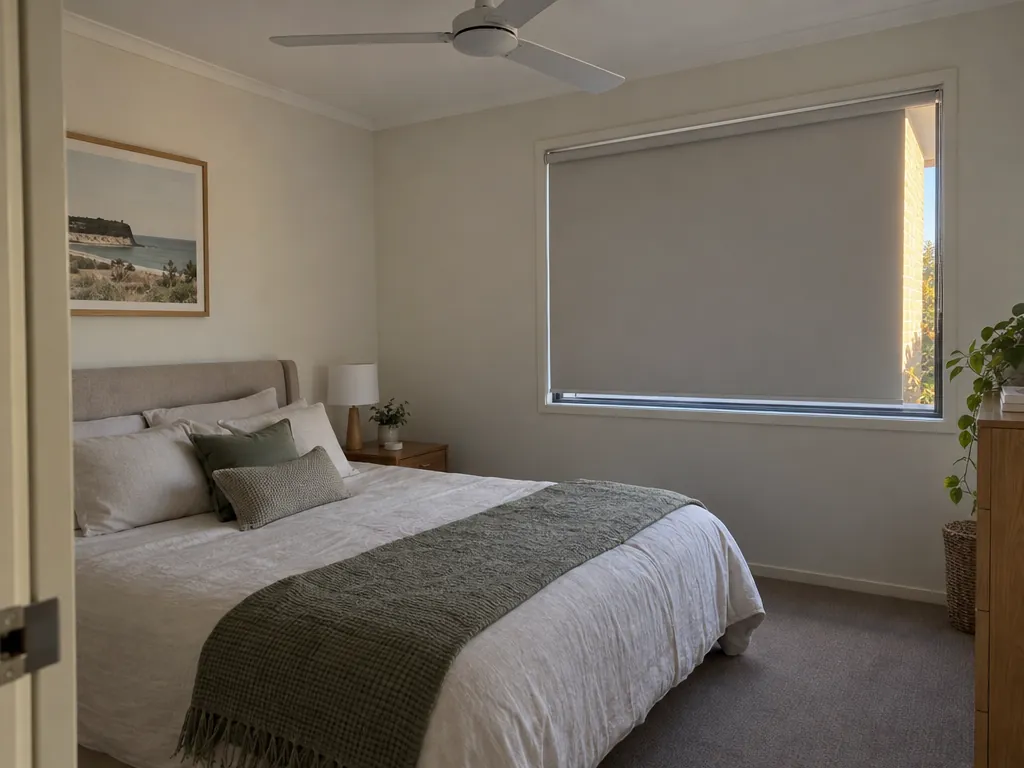
What a bedroom blind or curtain should do on a hot day
Does the bedroom covering do its job on a hot day?
Signs of gaps letting air through
- Rattling or whistling in wind
- Curtains moving with the window shut
- A breeze near closed windows
energy.gov.au sets out what a covering needs to do to hold heat out:
- It should reach the floor and wrap to the wall on either side of the window.
- It should be lined with a light-coloured "block out" backing.
- It should be made of tightly woven material to trap moving air.
Gaps undo good fabric. The signs of draughts include rattling or whistling in wind, moving curtains, or a breeze near closed windows.
How a blind sits on the window decides how big the side gaps are. Our reveal fit or face fit guide explains the difference.
If you're still choosing the fabric itself, our block-out or light filtering bedroom blinds guide covers that choice. Our page on blockout blinds is the next step from there.
The night routine: open window, fan, then air conditioning
- Ideal sleeping temperature: around 17 to 19 °C (Sleep Health Foundation)
- Air conditioner summer setting: 23 to 26 °C (NSW summer tips)
- Air conditioner on hot days: 24 to 26 °C, cool only the rooms you use (NSW hot-weather page)
A fan can make a room feel about 3 °C cooler (NSW summer tips)
Cool a room with the windows closed, unless you use an evaporative cooler.
The Sleep Health Foundation puts the ideal sleeping temperature at around 17 to 19°C. On a warm night most bedrooms won't get there. Its fallback is air flowing over the skin, and a fan can help.
Work through the steps in this order:
- Open up at sunset. Raise the coverings and open the window. An open window helps overnight, but watch for mosquitoes and flies, which is what a flyscreen is for.
- Fan next. NSW says a fan costs "about 2 cents an hour" and can make a room feel "about 3°C cooler" (checked November 2026). Fans cool people, not rooms, so switch them off when you leave, and set the blades counter-clockwise in summer.
- Keep a light cover handy. Core body temperature bottoms out around 3 to 5am, so have a light cover ready.
- Air conditioning last. The summer tips suggest 23 to 26°C. The hot-weather page suggests 24 to 26 degrees, cooling only the rooms you use. Always cool a room with the windows closed, unless using an evaporative cooler.
Comfort and safety come before the power bill. In NSW's words: "If you can't safely reduce the amount of energy you need to stay cool, don't attempt to."
If you move the bed or a fan nearer the window on a warm night, keep cords in mind. NSW rules say a corded blind must be installed so a loose cord cannot form a loop of 220 mm or longer at or below 1,600 mm above the floor, and, separately, keep cots and beds away from cords.
For the same order applied across the whole house, see our guide to keeping a Newcastle house cool in summer.
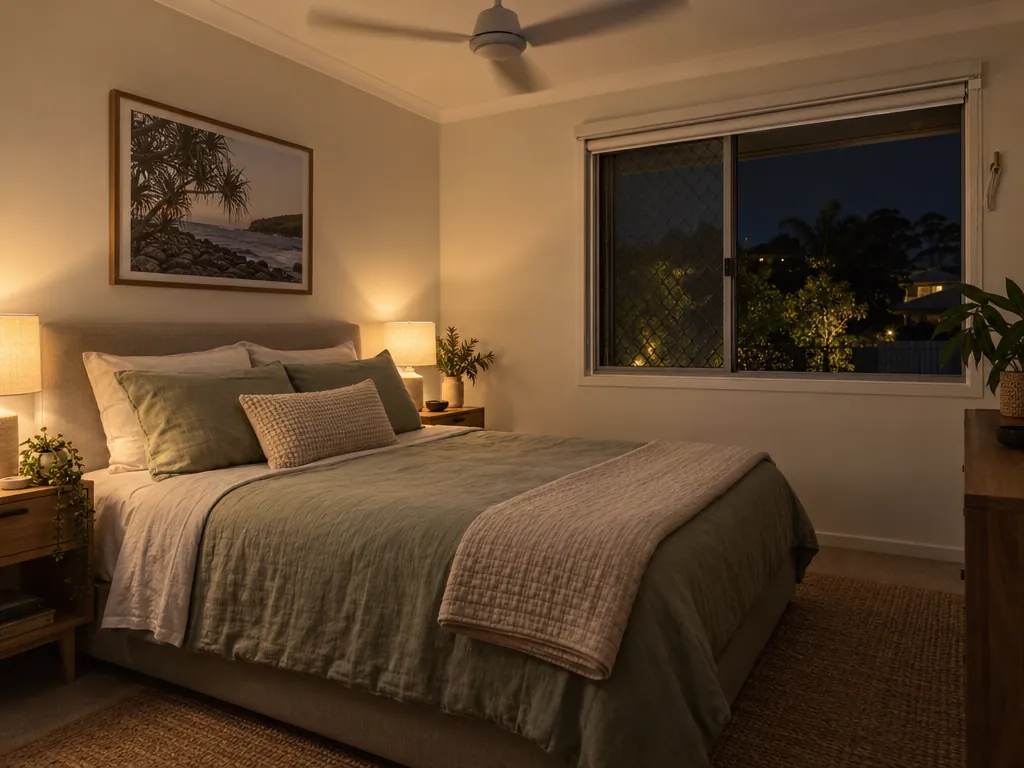
What blinds can't do on their own
Covering inside the glass
External shading
blocks the sun before it passes through the glass
Stopping sun hitting the window has a much larger effect than better glass.
Here is our honest view. An inside blind cuts the heat a bedroom takes on during the day, but it won't bring a warm room down to 17 to 19°C on a hot night. It gives the fan and the evening breeze a better starting point.
Shading outside the glass is the stronger option. External shading blocks the sun before it passes through the glass. The NSW hot-weather page suggests it if the sun hits the window.
There is no help with the cost. The NSW page says there is currently no NSW or Australian Government incentive or rebate for external shading (checked November 2026). Our guides to which side of the house to shade first and external blinds for west-facing windows cover that decision.
Some bedrooms simply hold heat longer. Your Home warns that badly positioned thermal mass "radiates heat well into the night", and says to avoid or limit it in upstairs sleeping areas. If your bedroom is upstairs with heavy masonry that takes the sun, shade it earliest in the day and expect it to cool down later at night.
The bedroom plan at a glance
By day, on hot days
coverings closed all day when the forecast is hot
Sunset
open coverings to let the evening breeze through; open the window, but watch for mosquitoes and flies
Fan first
can make a room feel about 3 °C cooler; blades counter-clockwise in summer; fans cool people, not rooms
Air conditioning last
23 to 26 °C (summer tips) or 24 to 26 °C (hot weather), windows closed unless it's an evaporative cooler
NSW summer tips; NSW hot-weather page; energy.gov.au, windows
Ideal sleeping temperature around 17 to 19 °C; core temperature lowest around 3 to 5 am.
- By day, on hot days: coverings closed all day when the forecast is hot.
- At sunset: open the coverings to let the evening breeze through.
- Fan first: a fan can make a room feel about 3°C cooler.
- Air conditioning last: 23 to 26°C or 24 to 26 degrees on hot days, with the windows closed unless it's an evaporative cooler.
Getting a bedroom ready with Blinds Newcastle
Start with one bedroom tonight. Pull the blind down and look at what you can see:
- daylight round the sides,
- a gap above the floor,
- fabric that lets the glare straight through.
Any of those is a gap in what energy.gov.au describes, and it's worth fixing before the warm nights settle in.
When you get in touch with Blinds Newcastle, tell us which way the bedroom faces and whether it's upstairs. Book through our Free Measure & Quote page and we'll take it from there.
Sources
- https://www.bom.gov.au/climate/ahead/outlooks/archive/20261029-outlook.shtml
- https://www.miragenews.com/long-range-forecast-november-2026-to-january-1768690
- https://www.bom.gov.au/video/long-range-forecast-november-2026-to-january-2027
- https://www.bom.gov.au/resources/learn-and-explore/heatwave-knowledge-centre/what-is-a-heatwave
- https://www.energy.gov.au/households/windows
- https://www.energy.nsw.gov.au/households/tips/summer-winter
- https://www.energy.nsw.gov.au/households/action/power-disruption/hot-weather
- https://www.energy.nsw.gov.au/households/upgrades/ceiling-fans
- https://www.energy.nsw.gov.au/households/upgrades/external-shading
- https://www.sleephealthfoundation.org.au/sleep-topics/hot-nights-how-to-help-sleep
- https://www.yourhome.gov.au/passive-design/passive-cooling
- https://www.nsw.gov.au/legal-and-justice/consumer-rights-and-protection/safety/other-consumer-products/blind-and-curtain-safety
Pictures in this guide are illustrations, not photos of our jobs.