

Home / Guides / Which side to shade first
Guide · summer shading
External window shading in Newcastle: which side of the house to shade first
Newcastle sits in climate zone 5, where federal guidance is horizontal shade over north windows (adjustable on the north-east and north-west so winter sun still gets in) and adjustable shading that comes down over east and west windows, such as an external blind, so start with whichever glass takes direct sun with nothing over it.
Which side of a Newcastle house to shade first
Shade by orientation: a Newcastle house from above
- North: Fixed or adjustable horizontal shading above the window
- North-east and north-west corners: Adjustable shading, so winter sun can still be let in
- East and west: Vertical louvres or blades, external blinds, or deep verandas or pergolas with deciduous vines
- Roof skylight: External blinds or louvres: almost twice the heat of an unprotected west window
Newcastle sits in NCC climate zone 5, warm temperate. For that zone, the federal Your Home guide says to provide passive solar shading to all north-facing openings and to use adjustable shade screens or deep overhangs to the east and west.
Read those two pages together and a Newcastle home has its plan. North glass gets horizontal shade. East and west glass gets shade that comes down over it. The exception that matters most is in Your Home's orientation table: north-east and north-west windows need adjustable shading so winter sun can still be let in.
Which side goes first is a judgement call. Ours at Blinds Newcastle is simple: start with glass the sun hits directly that has nothing over it.
The reason is heat. Direct sun can generate the same heat as a single bar radiator over each square metre, and effective shading can block up to 90% of that heat. Take an unshaded 2 m² west window in full afternoon sun. By our estimate, the sun on it carries roughly the heat of two bar radiators (2 m² × one radiator per square metre).
Here is how that plays out on most houses:
- Skylights and west windows first. They take the most heat and are the hardest to shade with anything fixed. Both get their own sections below.
- North windows with no eave next. They are the easiest to fix, and the north-east and north-west corners need the adjustable kind.
- East windows after that. The morning heat they let in builds through the day.
- North windows under a decent eave last. Check them against the eave table further down.
There's time to do this calmly. BOM's October to December outlook, as reproduced by Mirage News, says temperatures are likely above average for almost all of Australia, with an increased risk of heatwaves. Its later November to January outlook gives a more than 50% chance of unusually high maximums, over 70% across eastern NSW.
Yet Newcastle's forecast issued on 28 October showed highs of 24 to 27°C for the week ahead. That gap is your window for measuring and ordering.
North windows: the easiest to shade, as long as winter sun still gets in
How an eave lets winter sun in and keeps summer sun out
The Australian Government's energy site puts it plainly: for most of Australia (excluding northern Australia), glazing facing the north is the simplest to shade. Newcastle is well south of that exclusion.
The sun does most of the work. On the north side, summer sun comes from a high angle and winter sun from a lower one. That means an eave, awning or other horizontal shade can block the summer sun and still let the winter sun in, with no daily effort from you. Your Home calls eaves generally the simplest and least expensive shading method for northern elevations.
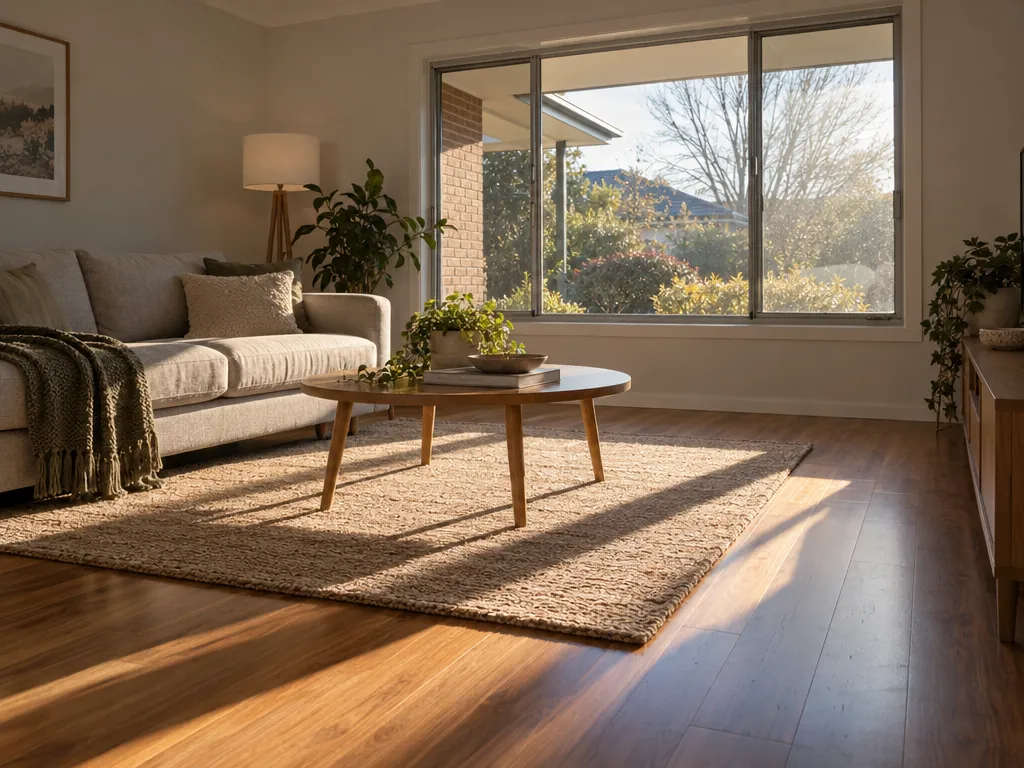
The catch is winter. Fixed shading that is badly designed can block beneficial winter sun, and that matters in a warm temperate town where July mornings are cold.
That's why we lean towards adjustable shade on any north window without a proper eave. The NSW Government notes that retractable awnings let winter sun in. Adjustable shade is also what Your Home recommends for the north-east and north-west corners.
Sizing an eave or awning, if you're renovating
Sizing an eave from the sill-to-eave height
| Sill-to-eave height | Standard eave overhang |
|---|---|
| 900 to 1200 mm | 450 mm |
| over 1200 to 1350 mm | 600 mm |
| over 1350 to 2100 mm | 900 mm |
| 2100 to 2700 mm | 1200 mm |
| Rule of thumb: eave width is 45% of the height from windowsill to the underside of the eaves; extend past each side of the window by the same distance as the projection. | |
Eave sizing is a job for your builder or designer, but the rule of thumb is worth knowing. Your Home says eave width should be 45% of the height from windowsill to the underside of the eaves.
Take a window with 2,000 mm from sill to eave. By our arithmetic, 45% of that is 900 mm, which matches the table's 900 mm for heights over 1,350 to 2,100 mm. Width matters too: horizontal shading should extend past each side of the window by the same distance as its projection.
New homes in NSW also go through BASIX. Its shading rules treat devices that "pull down or across to completely cover the window" as external louvres or vertical blinds. It counts them as fixed or adjustable depending on whether they retract to let winter sun in. BASIX says a projection less than 500 mm above the window head will typically provide reasonable shading. Its DIY method counts only half the projection when the leading edge is between 500 and 1,500 mm above the window head, and none above 1,500 mm.
West and east windows: low sun needs shade that comes down
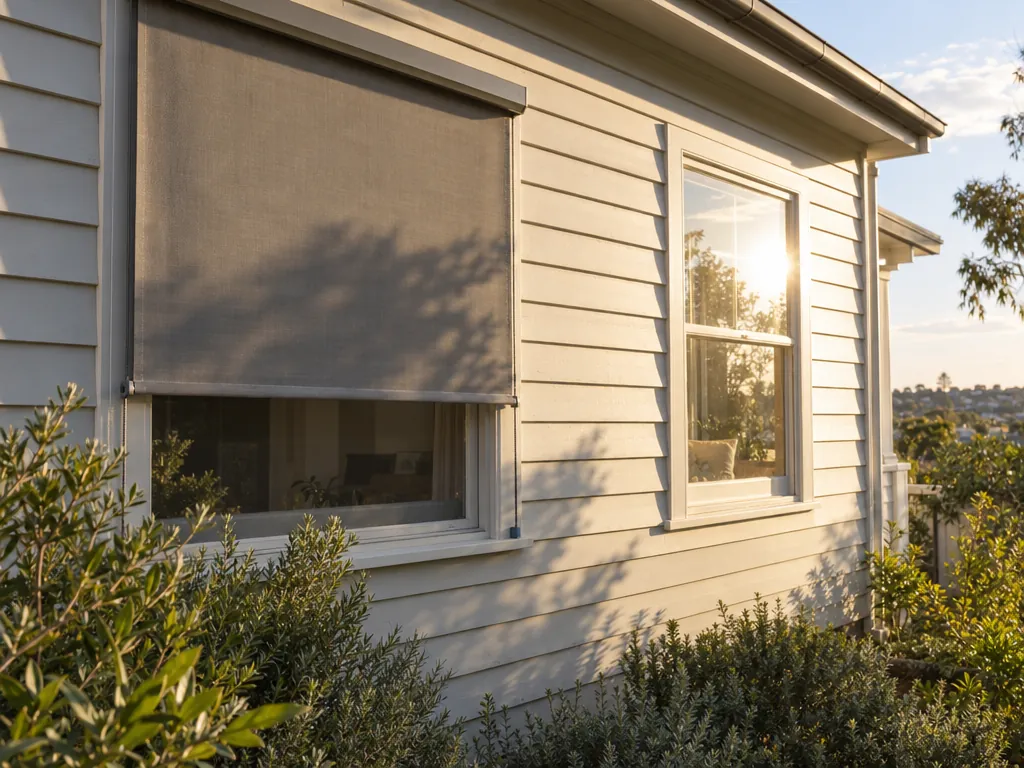
Morning and afternoon summer sun arrives low, which makes it harder to shade. An eave does little against it. Your Home's verdict is direct: adjustable vertical shading, such as external blinds, is the optimum solution for these elevations. Its orientation table also lists vertical louvres or blades, or deep verandas or pergolas with deciduous vines. Even so, deep verandas and pergolas can still admit very low-angle sun.
The NSW Government says external shading is best suited to windows facing west that get intense direct sun. It is also useful for glare and for protecting furniture and floors from UV fading.
Don't skip the east side. The house is cooler in the morning, but east gain starts a cumulative process that causes discomfort in the afternoon and evening.
We've covered the west side in detail already. Our guide to external blinds for west-facing windows and the page on blinds for west-facing rooms go further than this one. So does our heat-control blinds page.
Skylights: the hottest glass in the house
Same area, almost twice the heat
Roof glazing receives almost twice as much heat as an unprotected west-facing window of the same area. Protect it with external blinds or louvres.
Direct sun: about the heat of a single bar radiator over each square metre.
If your house has a skylight, it may be the single hottest piece of glass you own. Your Home says roof glazing receives almost twice as much heat as an unprotected west-facing window of the same area, and recommends protecting it with external blinds or louvres.
Go back to that 2 m² west window, worth roughly two bar radiators in full sun. By the same rough arithmetic, a skylight of that size could be receiving close to double. That figure is our estimate, built from Your Home's two figures above.
The energy.gov.au page includes skylights when it says shading windows, glass doors and skylights can have a significant impact on comfort and energy bills.
Outdoor blinds in Newcastle: what an external blind can and can't do
What an external blind can and can't do
| Can | Can't, or not on its own |
|---|---|
| Stop the sun's energy before it passes through the glass | Stay out in storms or high wind (retract awnings) |
| Effective shading can block up to 90% of direct-sun heat | Attract a NSW or Australian Government rebate |
| Retract or open in winter to let sun in | Suit every window (near a boundary, look for glass with an SHGC of no more than 0.20) |
| Help with glare and UV fading of furniture and floors | Stop an insulated house overheating if the windows go unshaded |
The big advantage is position. Outside shading can block the sun's energy before it passes through the glass, so the heat never gets into the room. Shading also does more than glass upgrades: Your Home says shading windows has a much larger effect than choosing better glass.
The limits are just as real.
- Weather. The NSW Government says to use shades during the hottest part of sunny days, retract awnings in storms or high wind, and keep shades retracted or open in winter. The same week's Newcastle forecast flagged showers and a chance of storms from 31 October, which is a fair reminder.
- Windows with no room for shading. Some windows can't take an external blind, such as one close to a boundary. There, Your Home suggests glass with a solar heat gain coefficient (SHGC) of no more than 0.20.
- Insulation alone. Insulation without summer shading can trap heat inside, creating what Your Home calls an "oven" effect.
- Installation. Solar screens can often be DIY, but awnings and shutters should be professionally installed so they are mounted safely. Check with your council or owners corporation before fixing anything to external walls.
Every house is different, and the energy.gov.au page says so. It notes that the best approach depends on climate and orientation and recommends personalised advice from an energy assessor, building designer or other professional.
Inside coverings still do their part
A warm-month day, left to right
Daytime
close window coverings; use external shades during the hottest part of sunny days.
3 pm to 8 pm AEDT
demand on the grid is high; fans before air conditioning; air conditioner set between 24 and 26 degrees.
Sunset
open coverings to let the evening breeze through.
Cooler months
Open coverings in the day when the sun is shining in; keep external shades retracted or open.
Outside shading and inside coverings work together, not instead of each other. The energy.gov.au routine is easy to follow: in warmer months, close window coverings during the day, then open them when the sun sets to let the evening breeze through. In cooler months, open them during the day when the sun is shining in.
The NSW Government's hot-weather advice is in the same spirit: "Close your curtains or consider external shading if the sun hits the window." It also suggests fans before air conditioning, with the air conditioner set between 24 and 26 degrees, and notes that demand on the grid is high between 3 pm and 8 pm AEDT. Our guide to keeping a Newcastle house cool in summer works through that order room by room.
For the inside layer, energy.gov.au recommends coverings that are close-fitting, lined with a light-coloured "block out" backing, and made of tightly woven material. They should reach the floor and wrap to the wall on either side of the window. If you're weighing fabrics, our guide to blockout, light-filter or sheer compares them.
Corded inside blinds: a safety check
If any inside blind has a cord, the national mandatory standards that NSW Fair Trading sets out say it must be installed so a loose cord can't form a loop of 220 mm or longer at or below 1,600 mm above the floor. Any cleat must sit at least 1,600 mm above the floor. Before you shorten a cord, check that cutting it won't void the warranty.
Some vertical blind and curtain pull-cords need a continuous loop to work and can't be cut, so they need a safety device that secures the cord out of reach instead.
What external shading costs, and why no rebate applies
What external shading costs, low end to high
NSW Government cost range (checked October 2026). No NSW or Australian Government rebate for external shading.
The NSW Government puts external shading at between $200 for a custom DIY solar screen and $5,000+ for a large motorised retractable awning (checked October 2026).
The same page claims savings of up to 40% a year on heating and cooling bills by cutting air-conditioner running time. That is the NSW Government's figure, not a promise for your house.
Shading isn't covered by a rebate: the NSW Government's external shading page says there is currently no NSW Government or Australian Government incentive or rebate for external shading. A loan is the exception. The NSW Home Energy Saver loan guidelines of 9 October 2026 list "E10: Install an external blind to a window or door" among the approved upgrades for a zero-interest loan. It spreads the cost; you still repay it. Our guide to external blinds for west-facing windows covers who the loan is for. Our guide to the NSW Energy Savings Scheme explains what that scheme does cover.
Before the first hot day: what to check
Before the first hot day: the checked facts
- Newcastleclimate zone 5Your Home, climate zones
- Northhorizontal shading above the window; north-east and north-west: adjustable, so winter sun gets inYour Home, shading
- East and westadjustable vertical shading such as external blindsYour Home, shading
- Skylightsalmost twice the heat of an unprotected west windowYour Home, shading
- Effective shadingblocks up to 90% of direct-sun heatYour Home, shading
- Eave width45% of sill-to-eave heightYour Home, shading
- Costfrom a custom DIY solar screen to a large motorised retractable awning (checked October 2026), no rebateNSW external shading page
- Corded inside blindsno loop of 220 mm or longer at or below 1,600 mm; cleat at least 1,600 mm upNSW Fair Trading, blind and curtain safety
Walk the house with your phone's compass and note which way each window faces. Give the most attention to skylights and west glass, as explained above.
Note which north windows already have an eave, and measure from sill to eave on the ones that do. That tells you, using the Your Home table, whether the eave is doing its job.
Mark any north-east or north-west windows, since those want adjustable shade.
Finally, check the cords on any inside blinds against the 220 mm and 1,600 mm rules.
Your next step: send us your window list
Once you know which windows face where, the order mostly sorts itself out. Write the list down: each window's direction, whether it has an eave, and any skylights. Then send it to Blinds Newcastle through our Free Measure & Quote page and ask for a measure and quote on the windows you want to shade first. Doing it now, while the highs are still in the mid-20s, means the shade can be up before the heat arrives.
Sources
- https://www.yourhome.gov.au/getting-started/australian-climate-zones
- https://www.yourhome.gov.au/passive-design/shading
- https://www.yourhome.gov.au/passive-design/passive-cooling
- https://www.energy.gov.au/households/windows
- https://www.energy.nsw.gov.au/households/upgrades/external-shading
- https://www.energy.nsw.gov.au/households/action/power-disruption/hot-weather
- https://www.miragenews.com/long-range-forecast-october-to-december-2026-1753529
- https://www.bom.gov.au/climate/ahead/outlooks/
- https://www.bom.gov.au/places/nsw/newcastle-west/forecast
- https://www.planningportal.nsw.gov.au/shading-projections
- https://www.energy.nsw.gov.au/sites/default/files/2026-10/Home_Energy_Saver_Loans_guidelines_October-2026.pdf
- https://www.nsw.gov.au/legal-and-justice/consumer-rights-and-protection/safety/other-consumer-products/blind-and-curtain-safety
Pictures in this guide are illustrations, not photos of our jobs.