

Home / Guides / Block-out or light filtering
Guide · bedrooms
Block-out or light filtering: choosing bedroom blinds for the daylight saving months
With NSW clocks going forward on 4 October, the question for your bedroom window is whether you want the morning light shut out or let in softly, and the answer depends on the sleeper more than the room.
NSW daylight saving runs from 2am on Sunday 4 October 2026, when clocks move forward to 3am AEDT, until April. That single hour then holds for the next six months, and the room it changes most is the bedroom.
The answer first: if you need to sleep past first light, you want block-out. If you are happy waking with the sun and mostly want privacy and glare control, light filtering does the job and keeps the room pleasant in the day.
What changes at your bedroom window
The clock change does not move the sun. It moves you. Sunrise and sunset both sit an hour later on the clock, so evenings stay bright well past dinner, and your body clock is briefly waking you at what used to be an earlier hour. The Reserve Bank's published schedule confirms the same date and mechanism for NSW, the ACT, South Australia, Tasmania and Victoria.
Two practical consequences for a bedroom. First, west-facing bedrooms take direct evening sun while people are winding down in them. Second, east-facing bedrooms deliver their morning light to a body that has not caught up yet.
Block-out blinds: sleep that ignores the sun
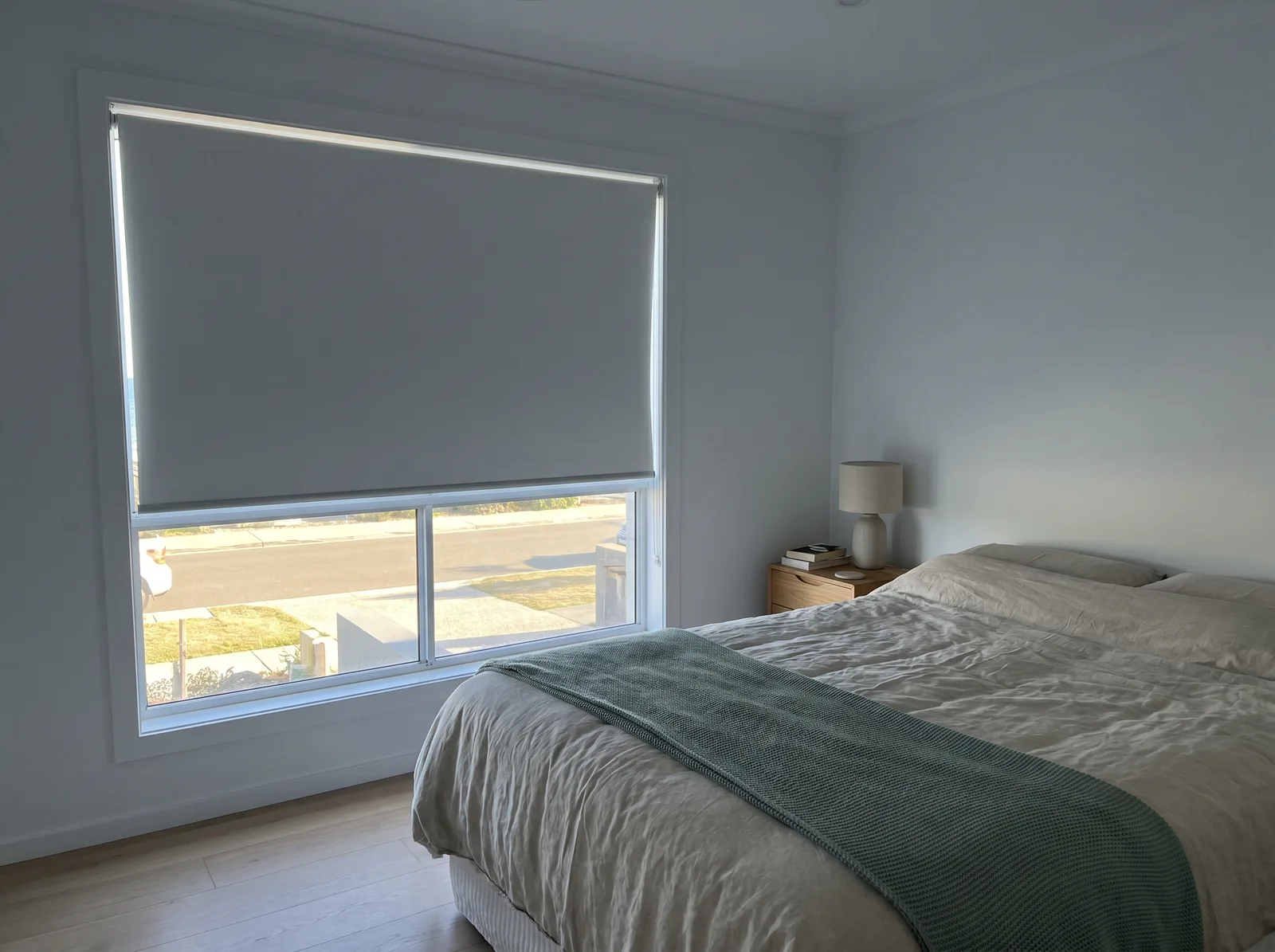
A block-out blind is built to stop light at the fabric, and the fit matters as much as the fabric. Light escapes around the edges, at the top and under the bottom rail, which is why a close fit in the reveal and a pelmet do the real work.
Block-out suits shift workers, anyone who sleeps in the morning after a late finish, babies and toddlers on daytime naps, and light sleepers who would rather not negotiate with dawn. It also gives you full privacy at night, when a lit bedroom behind a sheer fabric is a silhouette from the street.
Light filtering roller blinds: a softer glow that still cues the morning
Light filtering roller blinds diffuse the light instead of stopping it. You get daytime privacy and the glare taken off, with the room still bright enough to use without switching a lamp on.
There is a reason to want that after the clock change. The Sleep Health Foundation's fact sheet on daylight saving and sleep lists coping tips including making the bedroom as bright as possible on waking, getting outside in early morning sunlight, and keeping a consistent sleep routine. A light filtering blind does not fight that morning light. A block-out blind will, which is exactly the point if you need to sleep through it.
Neither is universally better. They answer different questions.
Which one suits which sleeper
| Consideration | Block-out | Light filtering |
|---|---|---|
| Morning light at the pillow | Stopped at the fabric. What still gets in comes around the edges, so the close fit and the pelmet decide the result. | Diffused, not stopped. The room lightens as the sun comes up, which is the point if you want waking cued. |
| Evening privacy with the light on | Full. A lit room behind it shows the street nothing. | Partial. Once you are the bright side, a lit room silhouettes against the fabric. |
| Daytime glow in the room | None while it is down. The room is dark, or the blind is up. | The whole reason for the fabric. Bright enough to use the room without switching a lamp on. |
| View out during the day | None while it is down. | None through the fabric either; it diffuses rather than reveals. A sheer is the fabric for a view. |
| Heat and cold at the glass | A lined or thermal-backed block-out, close-fitting with a pelmet, does the most of the two. | Trades some of that temperature control for the glow. |
If the room has to do both jobs, a dark bedroom at 6am and a usable room at 10am, you can run a light filtering fabric and a block-out fabric on the same window and choose per day.
The window is also a temperature problem
Light is only half of what comes through the glass. Australian Government energy guidance notes that almost 90% of a home's heat is gained, and up to 40% of heating energy is lost, through a home's windows. As Newcastle moves from spring into summer, that weak point flips from letting heat out to letting heat in.
Almost 90% of a home's heat is gained, and up to 40% of heating energy is lost, through a home's windows
The same guidance suggests you maximise temperature control all year round by installing close-fitting lined curtains or blinds and pelmets. Note what is doing the work there: close-fitting, lined, and a pelmet to close the gap at the top. A thermal-backed or lined block-out blind is doing double duty, light and temperature. A light filtering fabric trades some of that for the glow. That trade is worth making in a room you sit in during the day and worth skipping in a west-facing bedroom that bakes.
What to work out before you order
Walk the house once, room by room, in the evening and again first thing.
Your next step with Blinds Newcastle
Tell us about your bedrooms in your own words, however rough, through the enquiry form. We come to you, measure every window properly, and look at how each room actually gets used before we suggest block-out, light filtering or both on the one window. Then you get it all in writing, window by window, with the reason for each choice. The measure and the quote cost nothing and you're not committing to anything.
You can see the Newcastle areas we cover or get in touch with Blinds Newcastle to talk it through before the summer heat arrives on top of the longer evenings.
Sources
- NSW Government, Daylight saving: https://www.nsw.gov.au/about-nsw/daylight-saving
- Reserve Bank of Australia, Daylight saving schedule: https://www.rba.gov.au/schedules-events/daylight-saving.html
- Australian Government, energy.gov.au, Windows: https://www.energy.gov.au/households/windows
- Sleep Health Foundation, Daylight Saving and Sleep: https://www.sleephealthfoundation.org.au/sleep-topics/daylight-saving-and-sleep