Home / Guides / External blinds for west-facing windows
Guide · summer heat
External blinds for west-facing windows: shading a Newcastle home before the summer heat
Shade the windows that take direct afternoon sun, west first, and shade them on the outside of the glass, where the NSW Government calls external shading highly effective, but budget for it yourself because no NSW or federal rebate covers it.
Shade the windows that take direct afternoon sun, west first, and shade them on the outside of the glass. That is the case the NSW Government calls "highly effective". The season gives you a reason to do it now. BOM's outlook says "Both daytime and nighttime temperatures during October to December are likely to be above average for almost all of Australia", with an increased risk of heatwaves.
Then there is the money. We put three NSW Government pages side by side and counted the funding routes that pay for external shading. None is a rebate or discount:
- Rebates. Shading is not subsidised the way air conditioners are: the NSW page says there's "currently no NSW Government incentive or rebate available for external shading", and the same is true of the Australian Government.
- Energy Savings Scheme discounts. For households these cover "hot water systems, air conditioning systems, and battery energy storage". Shading is not on the list.
- Home Energy Saver loan. This is a zero-interest loan for double glazing or other eligible technology. The windows page does not mention shading, but the loan guidelines of 9 October 2026 list an external blind to a window or door as an eligible upgrade. It spreads the cost; you still repay it.
So treat shading as your own spend, and spend it on the glass that needs it most. The government says the cost of external shading ranges from a custom DIY solar screen to a large motorised retractable awning, depending on what you choose.
Why do west-facing windows need shading first?
The government's own example of where external shading earns its place is windows facing west that get intense, direct sun. Its hot-weather advice is broader and simpler: "Close your curtains or consider external shading if the sun hits the window".
Notice the condition: if the sun hits the window. A room isn't hot because of its compass point. It's hot because sun lands on the glass. With daylight saving under way since 4 October, the late sun now arrives during the hours you're home and using the room.
Blinds Newcastle's advice is to walk the house on the next sunny afternoon and note every window where sun is falling directly on the glass. That list is your shading plan. Our guide to blinds for west-facing rooms goes room by room from there.
Blinds to keep heat out: inside or outside the glass?
The same window, shaded outside and inside
Inside blinds still help. The government's summer advice is to close doors, windows, blinds and curtains during the day. It also says blinds, shades and curtains add insulation and control sunlight, and it notes that windows with a Low-E coating reflect heat.
But an inside blind meets the sun after the heat is already through the glass. External shading blocks the sun's energy before it passes through the glass, which avoids the "greenhouse effect" of heat trapped behind the window. That is the whole argument for external blinds on hot west glass.
If an inside blind is all a window can take, choose the fabric for the job. Our guide to blockout, light-filter or sheer explains the trade-offs.
External blinds, awnings, shutters or solar screens: which does what?
Four kinds of shading, side by side
| Option | What the NSW page says it does | Install | Winter |
|---|---|---|---|
| Awning | Cools windows, doors and outdoor areas | Heavier items such as retractable awnings "should be professionally installed" | Retractable ones let winter sun in |
| Solar screen | Replaces insect screens, blocks heat and UV, keeps the view | Can often be DIY | Keep open or retracted in winter |
| Shutters or exterior blinds | Reduce heat, add security, protect against storms | Professional install for shutters | Keep open in winter, especially south-facing |
| Internal blinds and curtains | Add insulation and control sunlight (windows page) | Not stated | Not stated |
| Cost | Ranges from a custom DIY solar screen to a large motorised retractable awning | ||
The NSW page sets out the outdoor options in plain terms:
- Awnings cool windows, doors and outdoor areas, and retractable ones let winter sun in.
- Solar screens replace insect screens to block heat and UV while keeping the view.
- Shutters or exterior blinds reduce heat, add security and protect against storms.
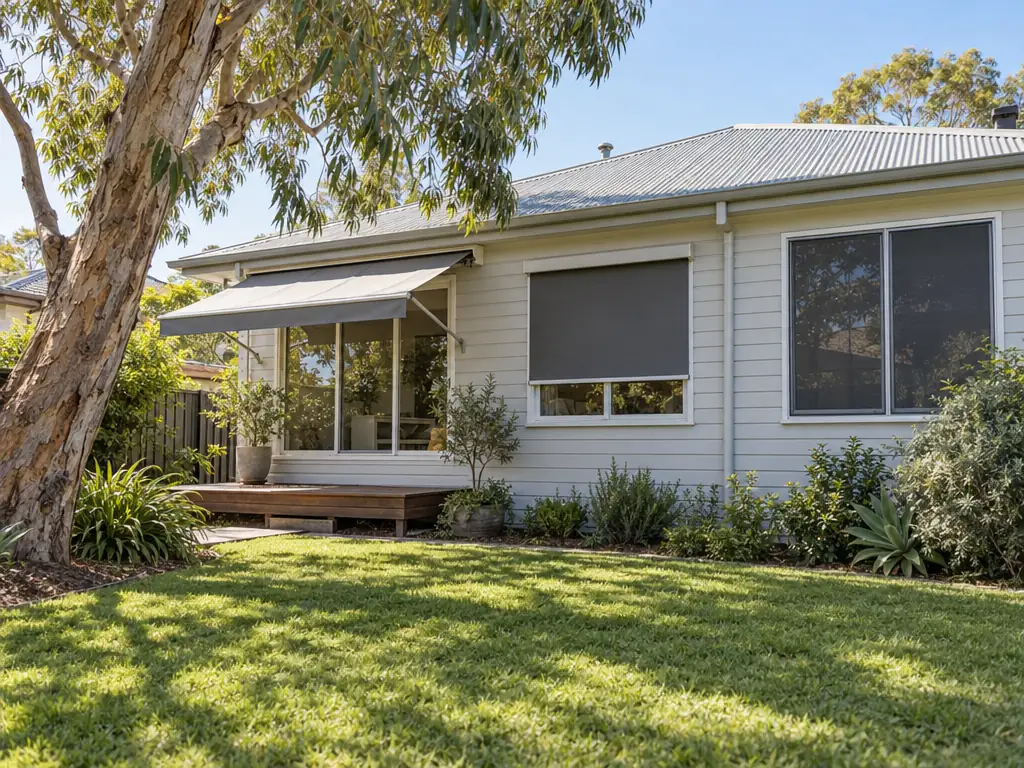
Installation divides the list. Solar screens can often be DIY, but heavier items such as retractable awnings or shutters "should be professionally installed". On the coast, also think about salt and UV wear. Our guide to blinds that survive coastal salt and UV covers the materials.
On results, read the claims for what they are. The government page says external shading can save "40% per year on your heating and cooling bills by reducing the time your air conditioner is running". That is a government claim, not a promise for your house. The same page quotes one NSW household that fitted insulated roller shutters on north, east and west-facing windows and said it cut the house temperature by about 10 degrees. That is one family's account of one home.
Building or renovating? BASIX treats shading in detail. An eave less than 500 mm above the window head typically gives reasonable shading, and removable shade cloth needs a shade ratio of at least 80% to count. Deciding between shutters and blinds inside as well? Read shutters or blinds, room by room.
How should you use blinds and shading on a hot day?
A hot day, hour by hour
The NSW page gives no hours for the hottest part of the day, so that band is drawn loosely.
Shading works when it's in use. The government's routine is short:
- Put shades down or awnings out during the hottest part of sunny days.
- Open windows at night to let the house cool.
- Try the fan first. It can make a room feel about 3°C cooler.
- Set the air conditioner to 23 to 26°C, with every degree higher saving about 10% on the cooling bill.
- Retract awnings in storms or high winds.
The last two points work together. Run the air conditioner at 26°C instead of 23°C and, by that 10% a degree rule, you'd trim something like 30% off the cooling part of your bill. That is our estimate (three degrees at about 10% each), from a government rule of thumb, not a promise. A fan gives the room a felt drop of about 3°C, which is what makes the higher setting bearable.
Two limits apply. In winter, keep shades retracted or open, especially on south-facing windows, so the sun's heat comes in for free. In a heatwave, safety comes first: if you can't safely cut the energy you need to stay cool, don't try.
Does UV still matter on a mild day?
UV on a mild day
Heat and UV are separate problems: Cancer Council says temperature does not affect UV levels, so a mild day can still be a high-UV day.
Newcastle has had a clear example recently. In mid-October, BOM's Newcastle West forecast predicted UV 8, Very High, on cloudy, showery days. Sun protection times are issued when the UV Index is forecast at 3 or above. At that level, "just 15 minutes of unprotected exposure ... can start to damage your skin".
The home side of this is the patio, the deck and the outdoor table. Cancer Council's advice is to seek shade, especially 10 am to 4 pm, and awnings cool outdoor areas as well as windows. National Skin Cancer Action Week runs 15 to 22 November, just before summer. It's a good prompt to check the shade where your family actually sits.
What are the cord rules for internal blinds?
Cord rules at the window
Plenty of homes will rely on internal blinds this summer, closed every afternoon. If they have cords, national mandatory standards set the limits. A loose cord must not be able to form a loop of 220 mm or longer at or below 1,600 mm above the floor. A cleat must sit at least 1,600 mm up. The installer must attach a label with their name and contact details.
Some vertical blinds use a continuous loop that can't be cut. These need a safety device that holds the cord out of children's reach. Check the warranty before cutting any loop. If you'd rather have no cord at all, our guide to blind mechanisms compares the options by household.
Who pays for external shading?
Three government routes, and what each does for shading
| Government route | What it covers | External shading? |
|---|---|---|
| NSW and Australian Government rebates or discounts | None for external shading, NSW or federal | No |
| NSW Energy Savings Scheme household upgrades | "hot water systems, air conditioning systems, and battery energy storage" | Not listed |
| Home Energy Saver zero-interest loan | zero-interest loan for double glazing or other eligible technology, for owners under a combined household income cap | Yes, as a loan you repay: the 9 Oct 2026 guidelines list an external blind to a window or door |
Mostly you do. The external-shading page shows no NSW or federal rebate or discount, and the Home Energy Saver loan below spreads the cost but is repaid. The Energy Savings Scheme discounts are aimed at hot water, air conditioning and batteries. Our earlier guide to what the Energy Savings Scheme covers explains how those discounts work.
The Home Energy Saver loan is real money, but read it carefully. It's for NSW homeowners or landlords under a combined household taxable income cap. The windows page says there is no Australian Government incentive for double glazing either.
Summer shading: the checked numbers
- External shading costfrom a custom DIY solar screen to a large motorised retractable awningNSW external shading page
- Government claim40% per year on heating and cooling bills; a government claim, not a promiseNSW external shading page
- Air conditioner23 to 26°C, about 10% saving per degree higherNSW summer tips
- Fanabout 3°C coolerNSW summer tips
- UV3 or above: 15 minutes unprotected can start damageCancer Council, Action Week
- Cord loopunder 220 mm at or below 1,600 mmNSW blind and curtain safety
- Home Energy Saver loanzero-interest, income cap applies, external blinds eligible (Oct 2026 guidelines)Loan guidelines, October 2026
- Rebates for external shadingnone, NSW or federalNSW external shading page
Your next step: list the windows the sun hits
On the next hot afternoon, walk the house and write down every window with sun on the glass, starting with the west side. Note whether each one could take an awning, an external blind, a solar screen or only an inside blind. Our guide to reveal fit or face fit shows what to measure, and The Window Finder helps you sort the rooms.
Then send that list to Blinds Newcastle through our measure and quote page and we'll talk through which windows to tackle first.
Sources
- https://www.bom.gov.au/video/long-range-forecast-october-to-december-2026
- https://www.miragenews.com/long-range-forecast-october-to-december-2026-1753529
- https://www.bom.gov.au/places/nsw/newcastle-west/forecast
- https://www.energy.nsw.gov.au/households/upgrades/external-shading
- https://www.energy.nsw.gov.au/households/tips/summer-winter
- https://www.energy.nsw.gov.au/households/action/power-disruption/hot-weather
- https://www.energy.nsw.gov.au/households/upgrades/windows
- https://www.energy.nsw.gov.au/households/grants-rebates/household-energy-saving-upgrades/household-energy-saving-upgrades-faqs
- https://www.planningportal.nsw.gov.au/shading-projections
- https://www.cancer.org.au/cancer-information/causes-and-prevention/sun-safety/uv-index
- https://www.cancer.org.au/cancer-information/causes-and-prevention/sun-safety/campaigns-and-events/national-skin-cancer-action-week
- https://www.nsw.gov.au/legal-and-justice/consumer-rights-and-protection/safety/other-consumer-products/blind-and-curtain-safety
- https://www.nsw.gov.au/about-nsw/daylight-saving
- https://www.energy.nsw.gov.au/sites/default/files/2026-10/Home_Energy_Saver_Loans_guidelines_October-2026.pdf