

Home / Guides / Keeping a house cool in summer
Guide · summer cooling
How to keep a Newcastle house cool in summer: blinds first, fans next, air con last
Government energy advice gives the same order for a cooler bedroom and living room: close blinds and curtains before the sun reaches the glass, open up to the evening breeze, fit coverings close to the wall and floor, and use fans before the air conditioner.
Close the blinds before the sun reaches the glass, and leave the air conditioner for last. Three separate government pages give that same first instruction for a hot day. energy.gov.au says to close the coverings during the day to keep your home cool. The NSW summer tips say to close doors, windows, blinds and curtains during the day and to use fans before the air conditioner. The NSW hot-weather page says to close your curtains or consider external shading if the sun hits the window.
Shade first, then fans, then air conditioning: all three pages start with the shade, and the two NSW pages put fans before the air conditioner. That is the order this guide follows, room by room. At Blinds Newcastle we think timing matters: a blind only helps if it is closed before the sun reaches the glass.
Why the windows matter most once the heat arrives
Up to 40% of a home's heating energy can be lost and up to 87% of its heat gained through windows.
Your Home, the Australian Government's design guide, says a home can have up to 87% of its heat gained through windows. energy.gov.au puts the same idea as “almost 90% of a home's heat is gained” through windows. Both are upper-end government figures, not what every home will see. Your Home also says unprotected glass is often the greatest source of heat entering a home.
The season looks set to test that glass. The Bureau of Meteorology's October to December outlook, as reproduced by Mirage News, says day and night temperatures are likely to be above average for almost all of Australia, and that the forecast indicates an increased risk of heatwaves. It adds that most of the country is very likely to have unusually warm nights for the rest of the year. Warm nights are a bedroom problem. The same release says September 2026 was Australia's second-warmest September on record.
Closer to home, the BOM forecast for Newcastle West issued 21 October had a max of 28°C for Saturday 24 and 29°C for Sunday 25 October, with UV reaching 9 (Very High) on the Saturday. Clocks went forward on Sunday 4 October and stay forward until Sunday 4 April 2027, so the routine below runs on summer time for the next six months.
When to close the blinds and when to open them
One hot summer day, on daylight saving time
Close coverings on any glass the sun is about to reach, and do it early. East rooms come first. Your Home warns that east-facing glass starts a cumulative heat build-up that causes discomfort in the afternoon and evening. Morning sun becomes evening heat.
Keep the house shut through the day. Opening windows in the heat of the day to let air in works against you: the NSW advice is to close windows during the day and open them at night.
Open up when the heat breaks. energy.gov.au puts it plainly: when the sun sets, open coverings to let the evening breeze blow through your home. Your Home says cool breezes only help where windows can be left open, meaning secure, quiet locations, so pick the windows you are comfortable leaving open.
One more time to know. In hot weather, demand on the grid is high from 3pm to 8pm AEDT. That is exactly when a room shaded since morning asks least of the air conditioner.
Bedrooms and living rooms need different routines
Bedrooms and living rooms, through a hot day
| When | Bedrooms | Living rooms |
|---|---|---|
| Morning | Close east glass by morning | Close west glass, and any north glass the eaves do not cover, before the sun reaches it |
| Daytime | Keep closed | Keep closed, cool only rooms in use |
| Late afternoon (3pm to 8pm AEDT, high grid demand) | Door shut if unused | Fan first, air conditioner at 23 to 26°C if needed |
| Evening and night | Open coverings at sunset and windows at night if secure and quiet | Open coverings at sunset for the breeze |
| Covering to look for | Lined, close-fitting, light-coloured block-out backing | Close-fitting coverings, external shading where sun is intense |
Bedrooms. The aim is a room that is still cool at bedtime, and the forecast warm nights make that harder. If the bedroom faces east, have the blind down by morning, before the sun is on the glass. Shut the door if nobody uses the room in the day: the NSW tips say to shut doors to unused rooms. Open the coverings at sunset and a window at night if it is secure and quiet.
Planning a renovation or an upstairs extension? Your Home advises that upstairs sleeping areas should avoid or limit thermal mass, because heavy materials hold heat into the night. If you are choosing the fabric itself, our guide to block-out or light filtering bedroom blinds covers that choice, and blockout blinds in Newcastle shows the options.
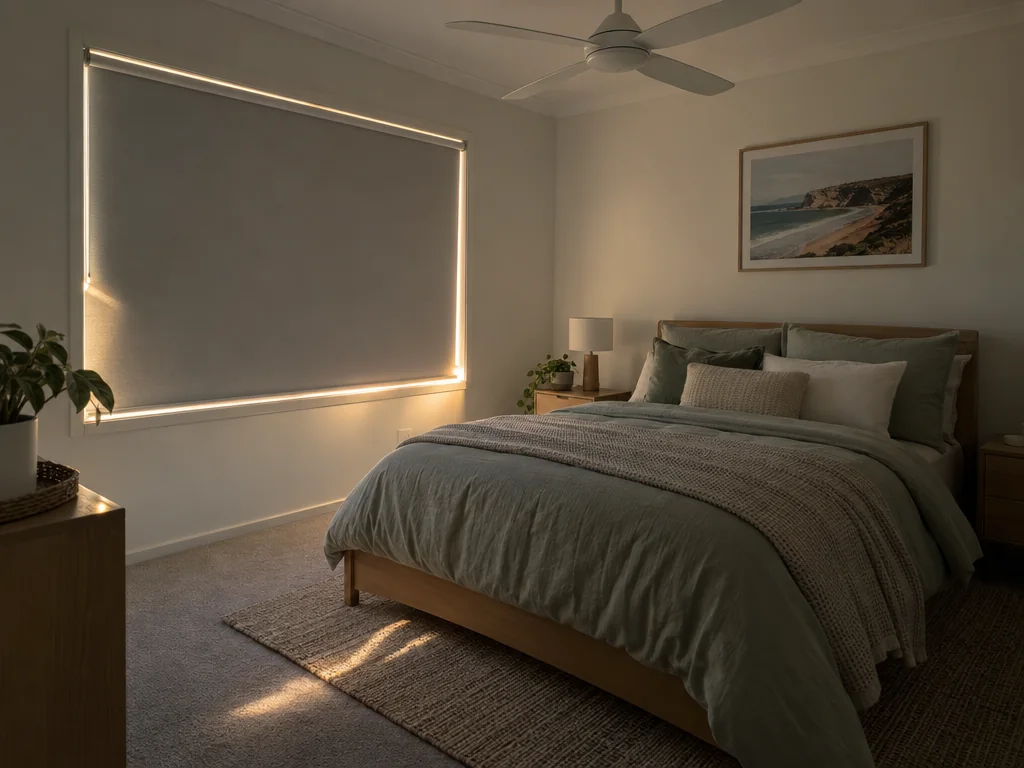
Living rooms. These carry the afternoon load. Shade the west glass, and any north glass the eaves do not cover, before the sun reaches it, then reach for a fan, and only then the air conditioner. The NSW hot-weather page suggests you “zone” your home by cooling only the rooms you use most, so close the living room off from the hallway while it is being cooled. Our guide to blinds for west-facing rooms goes further on the hardest window in the house.
Which windows let the most heat in
Where the sun lands through a summer day
- 1East glass starts a heat build-up felt later in the day
- 2Low east and west sun is hard to shade: adjustable external blinds are the optimum solution
- 3Skylight: almost twice the heat of an unprotected west window
- 4Sunset: open up for the breeze
Orientation matters more than most people expect. Low morning and afternoon sun comes in at a low angle, which makes it harder to shade. For east and west elevations, Your Home calls adjustable vertical shading such as external blinds the optimum solution.
Skylights are the surprise. Roof glazing gets almost twice as much heat as an unprotected west-facing window of the same area, and Your Home recommends protecting it with external blinds or louvres.
Heat through the same area of glass
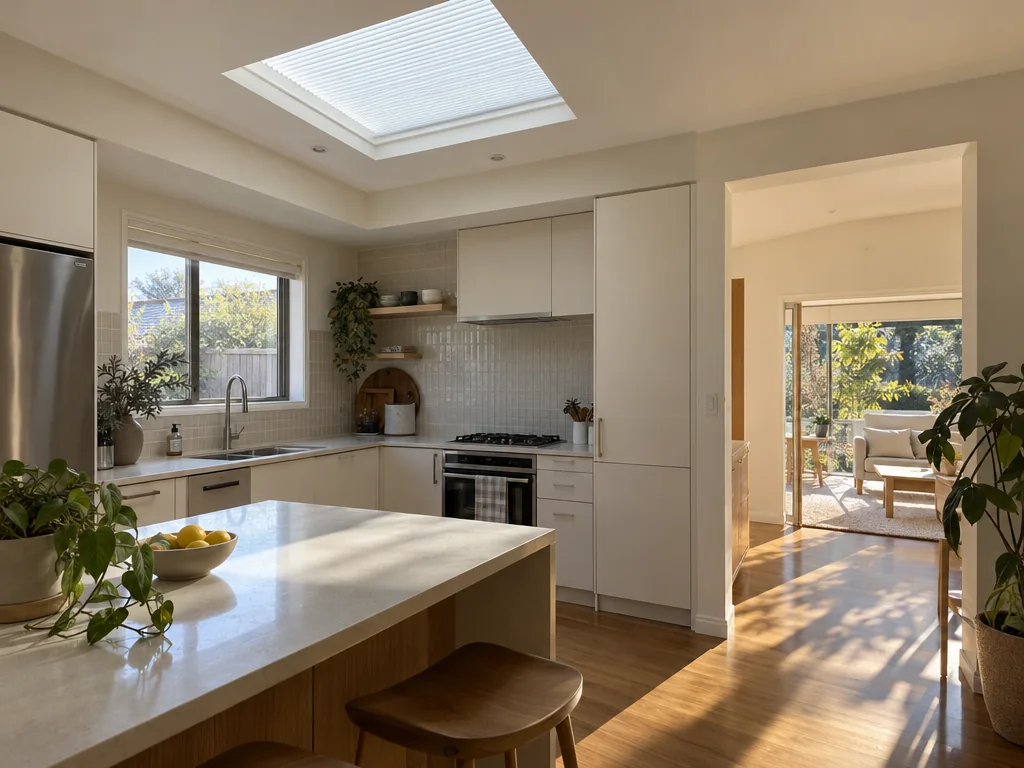
Inside or outside the glass? Both help, in different ways. Your Home says window furnishings such as louvres, blinds and curtains are especially useful to add to existing windows. That is the quickest fix for most homes. External shading goes further because it can block the sun's energy before it passes through the glass. Your Home says effective shading can block up to 90% of direct-sun heat, and that stopping sun reaching the window has a much larger effect than choosing better glass.
Larger external shading items such as shutters and awnings should be professionally installed. Do not count on a rebate to pay for it: the NSW energy site says there's currently no NSW Government incentive or rebate available, and none federally either.
Window film is another option for hot glass. Some films can halve a window's solar heat gain but may cut light, and film on glass in direct sun can cause thermal cracking, so Your Home says to use an accredited installer. For west windows in particular, our earlier article on external blinds for west-facing windows covers the outdoor options, and heat-control blinds shows what suits inside.
How a blind or curtain has to fit to keep heat out
How a covering fits to keep heat out
Top-down plan
Side section
Poor fit
A short curtain with open sides: air moves around it.
A covering that stops short of the wall lets warm air circulate around it. energy.gov.au describes the version that works: close-fitting lined curtains or blinds and pelmets. They should reach the floor, wrap to the wall either side of the window, have a light-coloured block-out backing to prevent heat loss in winter and heat gain in summer, and be made of tightly woven material that traps air.
For blinds, the same thinking points to how they are mounted. A blind fitted on the face of the frame can overlap the edges, while one inside the reveal leaves small side gaps. Our guide to reveal fit or face fit explains the trade-off.
Then seal the room. energy.gov.au says to always heat or cool a room with the windows closed, unless using an evaporative air cooler. Gaps make cooling work harder, and the signs are easy to spot: whistling in wind, moving curtains, or a breeze near closed windows.
Fit and gaps check, tick as you go
Fit
Gaps
Room
Keep blind cords out of children's reach when you change bedroom blinds
Cord safety check
If summer means new bedroom blinds, fit them safely. NSW Fair Trading says cords and chains on blinds and curtains can cause injury and death to young children and babies, and that babies can reach through cot slats to pull a nearby cord into the cot. Its advice: move cots, beds and other furniture away from cords, check every cord anywhere children are present, and make loose cords safe with a safety device. Two national mandatory standards apply to blind and curtain cord safety.
NSW Fair Trading sets the measurements: no loose cord should be able to form a loop 220 mm or longer at or less than 1,600 mm above floor level, and cleats must sit at least 1,600 mm up. Our guide to which blind mechanism suits which household covers cord-free ways to operate a blind.
The summer cooling order, from blinds to air conditioning
The summer cooling order
- 1
Shade
Effective shading can block up to 90% of direct-sun heat
- 2
Fans
About 2 cents an hour to run (checked October 2026); can make the room feel about 3°C cooler
Counter-clockwise in summer; fans cool people, not rooms
- 3
Air conditioner
Set to 23 to 26°C; every degree higher can save about 10%
3pm to 8pm AEDT: grid demand is high in hot weather
Once the glass is shaded, move air before you chill it. The NSW tips say fans only cost about 2 cents an hour to run (checked October 2026) and can make the room feel about 3°C cooler. Run a fan right through the five-hour 3pm to 8pm peak and, at that rate, it comes to about 10 cents: our estimate, five hours at about 2 cents an hour.
Ceiling fans have their own rules. Set the blades counter-clockwise in summer, and turn the fan off when you leave, because fans cool people, not rooms. A licensed electrician must install one. The NSW ceiling fans page claims fans with occasional air conditioning can cut energy use by up to 76% compared with air conditioning alone, an upper-end government figure rather than a promise.
When you do need the air conditioner, the NSW tips say to set it at 23 to 26°C, and that every degree higher can save about 10% on the cooling bill. A room that has been shaded since morning gives it less to do.
Getting your windows ready before the next hot run
Walk the house twice on the next sunny day, once mid-morning and once late afternoon. Note which rooms have sun on the glass, which coverings stop short of the wall or floor, where you feel a draught, and any loose cords near a cot or bed. That list is your summer plan.
If it shows coverings that do not close fully, do not fit, or need replacing in a child's room, Blinds Newcastle can measure the windows and quote: request a measure and quote. Not sure what each window needs? Start with The Window Finder, or read about homes like yours, from Cooks Hill terraces to Newcastle East and the harbour apartments.
Sources
- https://www.energy.gov.au/households/windows
- https://www.energy.nsw.gov.au/households/tips/summer-winter
- https://www.energy.nsw.gov.au/households/action/power-disruption/hot-weather
- https://www.energy.nsw.gov.au/households/upgrades/ceiling-fans
- https://www.energy.nsw.gov.au/households/upgrades/external-shading
- https://www.yourhome.gov.au/passive-design/glazing
- https://www.yourhome.gov.au/passive-design/shading
- https://www.yourhome.gov.au/passive-design/passive-cooling
- https://www.miragenews.com/long-range-forecast-october-to-december-2026-1753529
- https://www.bom.gov.au/places/nsw/newcastle-west/forecast
- https://www.nsw.gov.au/about-nsw/daylight-saving
- https://www.nsw.gov.au/legal-and-justice/consumer-rights-and-protection/safety/other-consumer-products/blind-and-curtain-safety
Pictures in this guide are illustrations, not photos of our jobs.