

Home / Guides / Dinner in the glare
Guide · evening sun
Dinner in the glare: taming evening sun in a west-facing living room
With the clocks forward, a west living room takes low, almost head-on sun through the dinner hours, so lower the west blinds before the sun reaches the glass, open them once it sets, and choose a covering that cuts heat and glare without leaving the room so dark that the lights go on.
If your living room faces west, the hardest sun of the day now arrives at dinner. The Bureau of Meteorology's Newcastle West forecast issued on 11 November recommended sun protection from about 8:40 am to 4:20 to 4:30 pm. In December, Newcastle's calculated sunset runs from 7:46 pm on 1 December 2026 to 8:04 pm on 31 December 2026.
Put those side by side and a west window can take roughly three more hours of sun after the sun-smart hours end. That is our estimate: 4:30 pm to 7:46 pm is 3 hours 16 minutes. The two figures come from different dates, so treat it as a guide, not a timetable. That late sun is low, it comes almost straight at the glass, and it lands on the hours you spend cooking, eating and watching TV.
The fix is a routine plus the right covering. Lower the west blinds before the sun reaches the glass, open them once it sets, and choose a covering that cuts heat and glare without making the room so dark that you switch the lights on. At Blinds Newcastle, our view is that in a west living room, keeping some daylight matters as much as stopping the heat.
Why does a west-facing living room get the sun at dinner time?
An evening clock for a west-facing living room
- Sun protection recommended until about 4:20 to 4:30 pm (BOM Newcastle West forecast issued 11 Nov 2026)
- 7:46 pm, 1 Dec 2026
- 8:04 pm, 31 Dec 2026
- Close the west blinds before the sun reaches the glass
- Open them at sunset to let the evening breeze through
Calculated times (Sunrise Almanac), not official
NSW daylight saving: Sunday 4 October 2026 to Sunday 4 April 2027
NSW daylight saving started on Sunday 4 October 2026 and ends on Sunday 4 April 2027 at 3am AEDT. The NSW Government says the change gives more daylight in the evening. That is 26 weeks in all, with about 20 still to run from mid-November (our count). This is a season-long routine, not one bad week.
The angle is what makes a west window so hard to live with. On a summer afternoon, a west window meets the sun at an angle of incidence from near 0° up to 30°, with a large effective area exposed. Near 0° means the sun is hitting the glass almost head-on. A north window in summer takes high-angle sun and transmits less heat than a west one.
Your Home puts it plainly: west-facing glass and walls are "a significant source of heat gain in hotter climates". East glass is no free pass either, because it starts a cumulative process that causes discomfort in the afternoon and early evening. A house with glass on both sides gets the morning's stored heat and the evening's direct sun in the same room.
How much heat are we talking about? Direct sun can deliver about the heat of a single bar radiator per square metre. A west window 2.4 m wide and 1.5 m high is 3.6 square metres of glass. In full sun, that is roughly three and a half single-bar radiators pointed at the dining table (our estimate, from Your Home's rule of thumb). Effective shading can block up to 90% of that heat.
Afternoon sun glare in the living room: is it heat, glare or fading?
| Option | What it does | The catch |
|---|---|---|
| External blinds or adjustable vertical shading | Blocks the sun's energy before it passes through the glass; Your Home calls adjustable vertical shading such as external blinds "the optimum solution" for east and west elevations | Retract awnings in storms or high winds; heavier items such as retractable awnings or shutters should be professionally installed; no NSW or Australian Government incentive or rebate as of the page's 15 Dec 2025 update (checked November 2026) |
| Internal covering lined with a light-coloured "block out" backing | Limits heat gain in summer; best when it reaches the floor, wraps to the wall on either side and is tightly woven | Close during the day, open at sunset to let the evening breeze through |
| Window film | Can roughly halve a window's SHGC; suits east and west elevations with long sun exposure | Can cut visible light; film on glass in direct sun can cause thermal cracking, so use an accredited installer |
| Deep veranda, balcony or pergola on the west | Shades higher sun | May still admit very low-angle summer sun; combine with planting or adjustable shading |
Three problems can hit the same room, and each one needs a different answer.
- Heat: the sun's energy coming through the glass and warming the room.
- Glare: a blaze of light across the TV or the table. NSW lists the need to reduce glare as a reason to shade.
- Fading: the same NSW page lists the need to protect your furniture and floors from fading due to UV exposure. The 11 November forecast had the UV Index predicted to reach 9 to 10, "Very High", a snapshot of the season rather than a fixed outlook.
External shading deals with heat best, because it blocks the sun's energy before it passes through the glass. Low-angle sun from east and west is "more difficult to shade" than north sun, and Your Home calls adjustable vertical shading such as external blinds "the optimum solution" for those sides. Vertical shading also lets in light, views and ventilation while excluding sun, which suits a room you actually sit in. Our earlier guide to external blinds for west-facing windows covers that option in detail.
An internal covering with a light backing is the inside answer. Coverings lined with a light-coloured "block out" backing limit heat gain in summer, and a block-out keeps direct sun off the TV and the table while it is down.
Light-filtering fabric is built to let light through. Expect it to do more for glare than for heat. It suits a west room once the worst sun has passed, or a window with some outside shade. Compare the fabric types in Blockout, Light-Filter or Sheer, and see Light-Filtering Blinds in Newcastle.
Window film can roughly halve a window's SHGC. SHGC is the solar heat gain coefficient, the share of the sun's heat that gets through the glass. Film suits east and west glass with long sun exposure, but it can cut visible light. Film on glass in direct sun can cause thermal cracking, so use an accredited installer.
A deep veranda or pergola helps, but on the west it may still admit very low-angle summer sun. Pair it with planting or adjustable shading. For west-room heat in general, see Blinds for West-Facing Rooms.
How do I stop evening sun heating my living room?
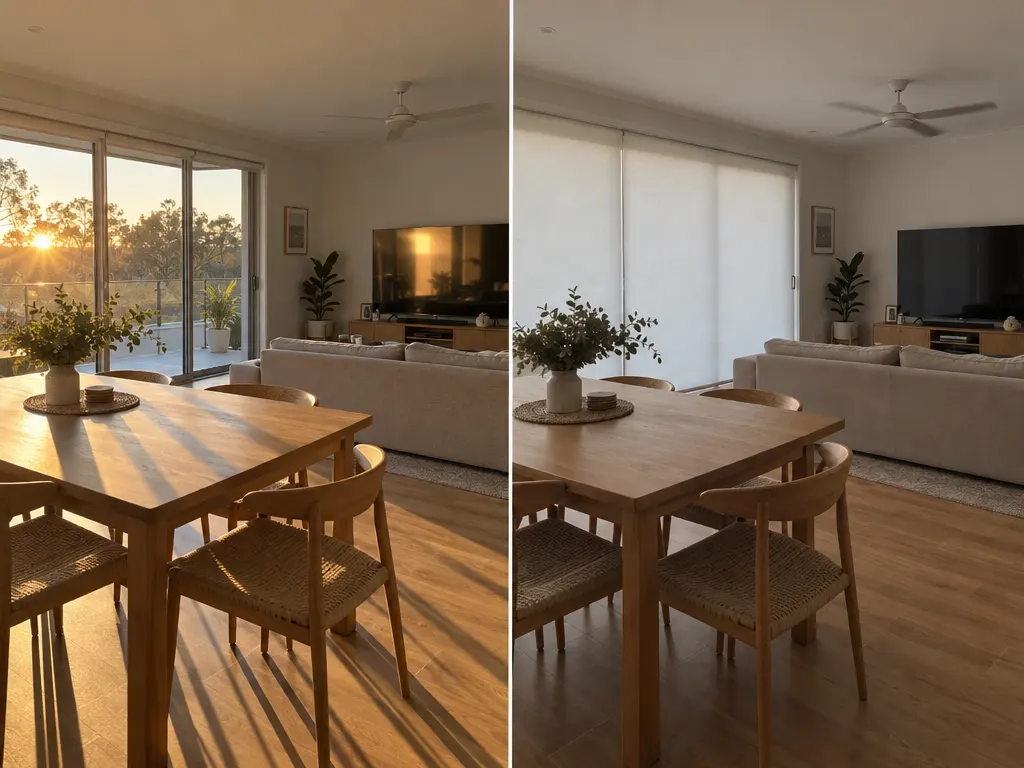
Closing the blinds is only half the job: the NSW and national advice is to close them during the day and open up in the evening to let the cooler air through.
The evening routine for a west room runs in three steps:
- Lower the west blinds before the sun reaches the glass. Once the sun is on the window, the heat is already coming in. On hot days, NSW advises you to close doors, windows, blinds and curtains during the day.
- Use the fan before the air conditioner. NSW says fans are cheap to run and can make a room feel about 3°C cooler.
- Open up at sunset. When the sun sets, open them to let the evening breeze through. Through December, that means after the calculated sunset of 7:46 pm or later.
The same rhythm carries on into the night. Our piece on blinds on a hot night covers bedrooms, and How to keep a Newcastle house cool in summer sets out the blinds, fans, air con order for the whole house.
Blinds for west facing windows that keep the room bright enough to use
An internal covering that keeps the heat out
- Reaches the floor
- Wraps to the wall on either side
- Tightly woven, lined with a light-coloured block-out backing
- Stops at the sill, short of the wall
A living room is not a bedroom. You want the sun's heat out, not the daylight. Your Home warns that if glass is too dark, the room gets gloomy and people switch lights on, which raises energy costs. A block-out that turns a 7 pm dinner into a cave has swapped one problem for another.
Three practical ways to keep both:
- Use two layers. A sheer over a block-out lets you drop the heavy layer for the hottest stretch, then switch to the sheer for glare and view. See Sheer Blinds & Dual Rollers in Newcastle.
- Cover the whole opening. Coverings should reach the floor and wrap to the wall on either side, and be tightly woven. A strip of sun past the edge of a blind lands straight on the floor or the couch.
- Choose the fit with that in mind. A blind inside the frame and one mounted over it cover the glass differently. Reveal Fit or Face Fit explains the trade-off, and The Window Finder helps you narrow down options by window.
Are the cords on living-room blinds safe for children?
NSW blind cord check
NSW limit 1: a loose cord must not be able to form a loop of 220 mm or longer at or below 1,600 mm above the floor.
NSW limit 2: a cleat must be at least 1,600 mm above the floor.
Enter your blind's measurements
Fix: use a safety device that secures the cord out of reach, or move the cleat to at least 1,600 mm above the floor.
- Before cutting a cord loop, check the blind still works and the warranty is not voided.
- Some vertical-blind pull-cords need a continuous loop and cannot be cut, so they need a safety device instead.
Living rooms are where children play, so check any corded blind against the NSW rule. Corded blinds must be installed so a loose cord cannot form a loop of 220 mm or longer at or below 1,600 mm above the floor. A cleat must be at least 1,600 mm above the floor.
Thinking of cutting a cord loop on an old blind? First check the blind still works and that the warranty is not voided. Some vertical-blind pull-cords need a continuous loop and cannot be cut, so they need a safety device instead. If you would rather avoid cords altogether, Which Blind Mechanism for Which Household compares the options.
Is there a rebate for external shading?
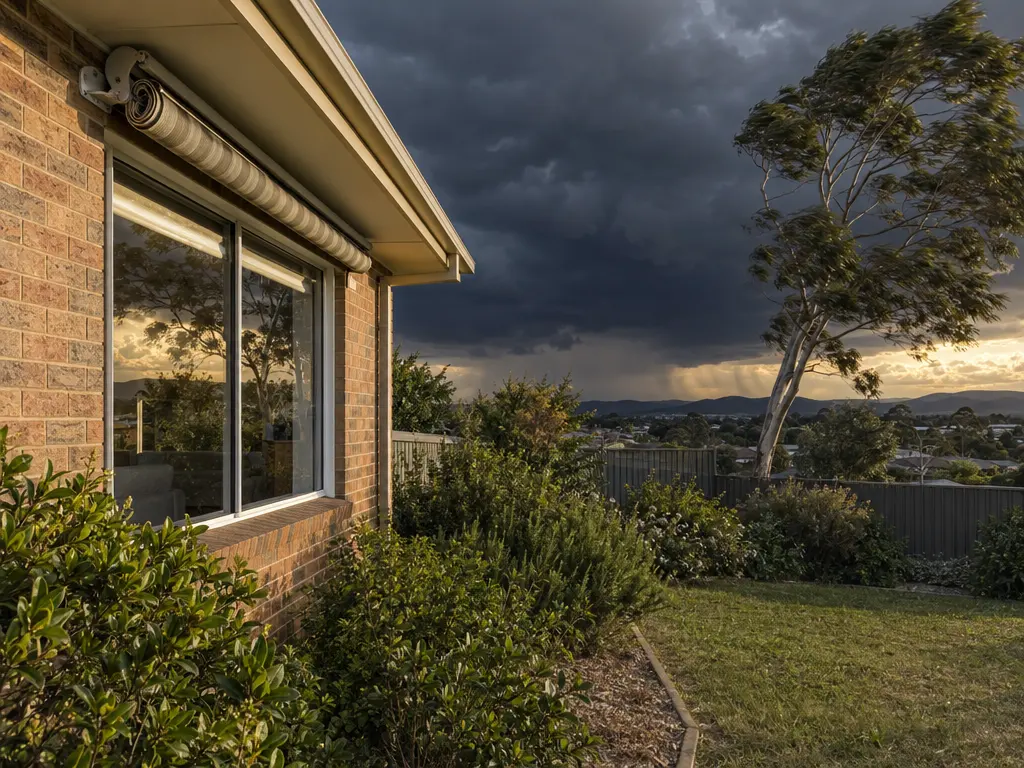
Cost depends on the option and the size of the window: NSW's own range runs from a custom DIY solar screen at the low end to a large motorised retractable awning at the top. Heavier items such as retractable awnings or shutters should be professionally installed, and you need to retract awnings in storms or high winds.
There is no help with the bill. As of its 15 December 2025 update, the NSW page says there is no NSW or Australian Government incentive or rebate for external shading (checked November 2026). Our guide to the NSW Energy Savings Scheme explains what that scheme does cover.
The same page cites savings of up to 40% a year on heating and cooling bills, from less air-conditioner running time. That is its figure for external shading in general. Your room's result depends on the window, the house and how you use it.
Tonight's test, then a measure
Before choosing anything, give the room one evening and take four notes:
- When the sun first lands on the west glass. That is your "close the blinds by" time.
- Where the glare falls. Note whether it hits the TV, the table, a timber floor or the couch. That tells you whether heat, glare or fading is the main job.
- How the room feels at sunset. If it is still warm with the blinds down, heat is the problem to solve first.
- What is outside the window. Note any veranda, pergola or tree, and whether the window is a door you walk through.
When you're ready, send those notes with a measure and quote request, and say the window faces west and gets the dinner-time sun. Blinds Newcastle will have the full picture of your evening before anyone reaches for a tape measure. The routine changes again when daylight saving ends on 4 April 2027. Until then, the low western sun is part of dinner.
Sources
- Daylight saving, NSW Government
- Newcastle sunrise and sunset times, December 2026, Sunrise Almanac
- Newcastle West forecast, Bureau of Meteorology
- Shading, Your Home
- Glazing, Your Home
- Windows, energy.gov.au
- Summer and winter energy saving tips, Energy NSW
- External shading, Energy NSW
- Blind and curtain safety, NSW Government
Pictures in this guide are illustrations, not photos of our jobs.